Last updated: February 2026
Yarn Drying
The use of radio frequency dryers has been well established as a means of drying textile yarns. The major benefit of a radio frequency dryer is that it removes water evenly throughout the yarn package.
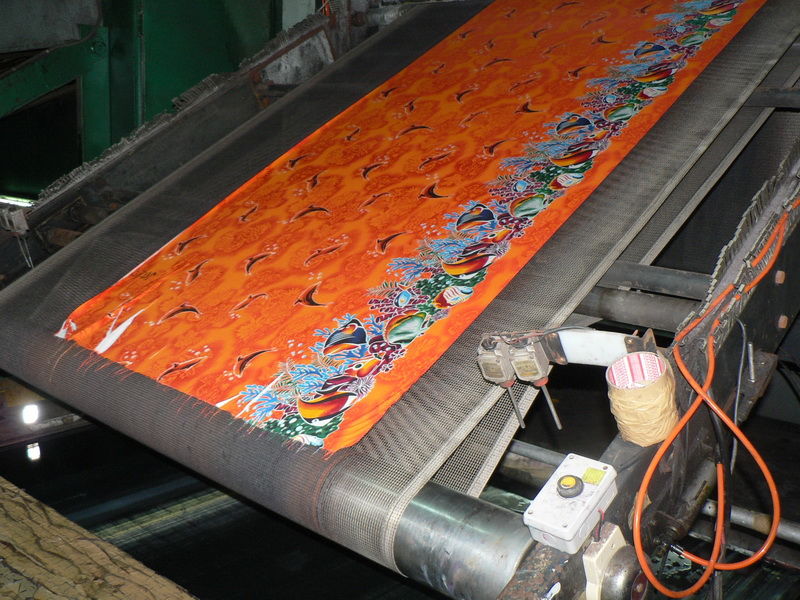
Conventional drying ovens dry yarn packages from the outside. This means that water content increases towards the center of the package and this effects the elongation characteristics of the yarn. In subsequent textile operations, knitting or weaving, such variations create serious manufacturing problems. Evenly dried yarn packages are therefore essential and can be produced typically on an open mesh PTFE KEVLAR belt, such as GORTEF 9003, with KEVLAR edge reinforcement and a non metallic joint.
Tell us the equipment and dimensions and we will quote the right material.
Yarn Preparation
Prior to weaving, most textile yarns are treated in some way to improve their handabililty and mechanical properties. Such processes usually involve treatment with materials that are sticky, and quickly contaminate heated rollers and cylinders leading to interference with processing. In many cases this problem can be overcome quite simply by covering all contact areas of rollers and cylinders with GORTEF 116.15AD
Important Note: Any surface to be covered must be absolutely clean and thoroughly dry. GORTEF ADHESIVE TAPE should be applied carefully to ensure no entrapment of air and then rubbed down vigorously to effect the best adhesion.
Finishing of Fabrics
A problem in the textile industry in the finishing of cloth, is the build-up of sizing, dye and lint on cylinders or "dry cans", and the resultant down time for clean-up.
This problem has been addressed by spray coating the drying cylinders with TEFLON. The many limitations to spray coating include; a source to do the work; the down time while the rolls are out of the plant; the cost of shipping the cylinders; the danger of damage to the coating in transit; and the high cost of spray coating.
The application of GORTEF 108.08 AD or GORTEF 216.13 AD to the "dry cans" eliminates the disadvantages of spray coating since the work may be done in the textile plant by plant personnel. Another advantage of using GORTEF ADHESIVE TAPE is that in the event of accidental damage, repair patching may be done without removing the roll from the equipment. And, in addition to the initial cost savings of GORTEF ADHESIVE TAPE over spray coating, the GORTEF ADHESIVE TAPE generally lasts two to three times longer.
You May Also Be Interested In
- Dryer Mesh Belts: Open-weave PTFE belts for drying applications
- Screen Printing: PTFE mesh belts for print drying
- Laminating: Tape for the rollers and platens that bond coated fabric
- High-Frequency Welding: Die release for PVC coated fabric, tarpaulin and truck curtain
- Teflon Tape Products: Tapes for textile drying cylinders
- What is Teflon Tape?: Guide to PTFE tapes and applications
Frequently Asked Questions
The textile industry uses PTFE coated glass fabric adhesive tapes for covering heated rollers and cylinders during yarn preparation, PTFE KEVLAR mesh belts (such as GORTEF 9003) for yarn drying in radio frequency dryers, and PTFE adhesive tapes for covering dry cans in fabric finishing operations.
PTFE tape prevents the build-up of sizing, dye, and lint on drying cylinders (dry cans), reducing downtime for cleaning. PTFE tape can be applied in-plant by maintenance staff, costs less than spray coating, lasts 2-3 times longer, and can be patch-repaired without removing the roll from the machine.
For radio frequency yarn dryers, an open mesh PTFE KEVLAR belt such as the GORTEF 9003 with KEVLAR edge reinforcement and a non-metallic joint is recommended. The open weave allows even airflow through yarn packages for consistent moisture removal.
